The WBSSC SLST Mathematics Syllabus 2025 is now available with the official notification. Check the detailed syllabus, exam pattern, marking scheme, important topics, and PDF download details to plan your preparation effectively and improve your chances of success.
WBSSC Assistant Teacher Recruitment 2025 Overview
WBSSC SLST Maths Syllabus 2025 is an essential guide for candidates preparing for the WBSSC SLST Recruitment 2025 exam. It provides a detailed breakdown of the topics to be covered in the exam. Below is an overview of the key details related to the WBSSC SLST Maths Syllabus 2025:
| Particulars | Details |
|---|---|
| Conducting Body | West Bengal Central School Service Commission (WBSSC) |
| Post Name | Assistant Teacher |
| Exam Dates | 7 September 2025 and 14 September 2025 |
| Medium | Bengali and English (as applicable) |
| Total Vacancies | 35,726 |
| Syllabus | Subject-specific syllabus for Classes IX–X and XI–XII |
WBSSC SLST Marking Scheme 2025
The WBSSC Assistant Teacher Recruitment 2025 selection process is based on a total of 100 marks, distributed across five components:
| Component | Marks |
|---|---|
| Written Examination (OMR-Based) | 60 Marks |
| Academic Qualification | 10 Marks |
| Teaching Experience | 10 Marks |
| Oral Interview | 10 Marks |
| Lecture Demonstration | 10 Marks |
| Total | 100 Marks |
SECONDARY (CLASSES IX AND X) 2016
MATHEMATICS (GRAD) CODE – 86
I Algebra
A. Classical Algebra:
1. Complex number: Definition on the basis of ordered pairs of real numbers. Algebra of complex numbers, modulus amplitude, conjugate, Argand diagram. Demoivre’s Theorem and its applications. Exponential, Sine, Cosine and Logarithm of a complex number. Definition of az (a ≠ 0). Inverse Circular and Hyperbolic functions.
2. Polynomial, Synthetic division. Remainder theorem: Fundamental theorem of Classical Algebra (statement only). Polynomials with real coefficients; the nth degree polynomial equation has exactly n roots. Nature of roots of an equation (surd or complex roots occur in pairs). Statement of Descarte’s Rule of signs and its applications. General properties of equations. Multiple roots. Rolle’s theorem and its application. Relation between roots and co-efficients, symmetric functions of roots. Transformation of equations. Cardan’s method of solution of a cubic.
3. Determinants up to the third order. Definition of a determinant, Properties, Minors and cofactors. Product of two determinants. Adjoint, Symmetric, and Skew-symmetric determinants. Solutions of linear equations with not more than three variables by Cramer’s Rule.
4. Matrices of Real Numbers: Definition, Equality of matrices. Addition of matrices, Multiplication of a matrix by a scalar. Multiplication of matrices. Scalar matrix, identity matrix. Inverse of a non-singular square matrix. Elementary operations on matrices, Rank of a matrix; determination of rank either by considering minors or by Sweepout process. Consistency and solution of a system of linear equations with not more than three variables by matrix method.
B. Modern Algebra:
1. Basic concepts: Sets, Subsets, Equality sets, Operations on Sets. Union, Intersection and Complement. Verification of the laws of algebra of set and De Morgan’s Laws. Cartesian product of two sets. Mappings One to one and onto mapping, composition of mappings, Identity and inverse mappings.
2. Introduction to Group Theory: Group Definition and examples taken from different branches (examples from number system, roots of unity, 2 × 2 real matrices, non-singular real matrices of fixed order). Elementary properties using definition of group. Definition and example of subgroup.
3. Definitions and examples of Ring. Field, Sub-ring, Sub-field.
4. Concept of Vector Space over a field: Examples, Concepts of linear combinations, Linear dependence and independence of finite set of vectors. Subspace, concepts of Generators and Basis of a finite dimensional vector space.
5. Real quadratic form involving not more than three variables – Problem only.
6. Characteristic equation of square Matrix of order not more than three. Determination of Eigen values and Eigen vectors – Problems only. Statement and illustration of Cayley–Hamilton theorem.
II GEOMETRY
A. ANALYTICAL GEOMETRY OF TWO DIMENSIONS.
- Transformation of Rectangular axes.
Translation, Rotation and their combinations. Invariants. - General Equation of second degree in x and y. Reduction to canonical forms classification of Conic.
- Pair of straight lines: Condition that the general equation of second degree in x and y may represent two straight lines. Point of intersection of two intersecting straight lines. Angle between two lines given by ax² + 2hxy + by² = 0. Equation of Bisectors. Equation of two lines joining the origin to the points which a line meets a conic.
- Equation of pair of tangents from an external point, chord of contact, poles and polars of ellipse and hyperbola.
- Polar equations of straight lines and circles, polar equation of conic referred to a focus as pole. Equation of chord joining two points. Equations of tangents and normals.
B. ANALYTICAL GEOMETRY OF THREE DIMENSIONS:
- Rectangular Cartesian co-ordinate. Distance between two points. Division of a line segment in a given ratio. Direction cosines and Direction ratios of a straight line. Projection of a line segment on another straight line. Angle between two straight lines.
- Equation of a plane: General Form, Intercept and Normal Form. Angle between two planes. Signed distance of a point from a plane. Bisectors of angles between two intersection planes.
- Equation of straight lines. General and symmetric form. Distance of a point from a line. Co planarity of two straight lines. Shortest distance between two skew-lines.
III DIFFERENTIAL CALCULUS
1. Rational numbers. Geometrical representation. Irrational numbers. Real numbers represented as points on a line – Linear continuum. Acquaintance with basic properties of real numbers (No deduction of Proof is included).
2. Sequence: Definition of bounds of a sequence and Monotone sequence. Limit of a sequence. Statement of theorems. Concept of convergence and divergence of monotone sequences – applications of the theorems, in particular, definition of e. Statement of Cauchy’s general principle of convergence and its applications.
3. Infinite series of constant terms. Convergence and divergence (definitions). Cauchy’s principle as applied to Infinite series (application only). Series of positive terms. Statements of comparison test, D’Alembert’s Ratio test. Cauchy’s root test Applications. Alternating series: Statement of Leibnitz test and its applications.
4. Real valued functions defined on an interval: Limit of a function (Cauchy’s definition). Algebra of limits. Continuity of a function at a point and in an interval. Acquaintances (no proof) with the important properties of continuous functions on closed intervals. Statement on existence of inverse function on a strictly monotone function and its continuity.
5. Derivative. Its geometrical and physical interpretation. Sign of derivative – Monotonic increasing and decreasing functions. Relation between continuity and derivability. Differential application in finding approximater. Successive derivative. Leibnitz’s theorem and its application.
6. Statement of Rolle’s Theorem and its geometrical interpretation. Mean value Theorems of Langrance and indeterminate Forms. L. Hospital’s Rules. Application of the Principle of Maximum and Minimum for a function of single variables in geometrical, physical and other problems.
7. Functions of two variables. Their geometrical representations. Limit and continuity (definitions only) for functions of two variables. Partial derivatives. Knowledge and use of chain rule. Differentiation of implicit functions of two variables (existence being assumed). Function of two variable successive partial derivatives. Statement of Schwarz’s Theorem on commutative property of mixed derivatives. Statement of Euler’s Theorem on homogeneous function of two variables. Maxima and minima of functions of two variables.
8. Applications of Differential calculus: Tangent and normal. Envelope of family of curves (problems only).
IV INTEGRAL CALCULUS
1.) Integrations of the form

and integration of rational functions.
2.) Evaluation of definite Integrals.
3.) Integration as the Limit of a sum (with equally spaced intervals).
4.) Reduction formula of

and associated problems (m and n are non-negative integers).
5.) Working knowledge of Double Integral.
6.) Rectification. Quadrature, volume and surface areas of solids formed by revolution of plane curves and areas.
IV DIFFERENTIAL EQUATIONS
- Order, degree and solution of an ordinary differential equation (ODE) in presence of arbitrary constants. Formation of ODE, First order equations.
- (i) Variables separable.
- (ii) Homogeneous equations and equations reducible to homogeneous forms.
- (iii) Euler’s and Bernoulli’s Equations (Linear)
- (iv) Clairaut’s Equation: General and Singular solutions.
- Second order linear equations: Second order linear differential equations with constant coefficients. Euler’s Homogeneous equations.
V VECTOR ALGEBRA
Definition of vector and scalar. Addition of vectors. Multiplication of vector by a scalar. Collinear and coplanar vectors, Scalar and vector products of two and three vectors. Simple applications to problems of Geometry.
VI ANALYTICAL DYNAMICS
1. Velocity and Acceleration of a particle. Expressions for velocity and acceleration in rectangular Cartesian and polar coordinates for a particle moving in a plane. Tangential and Normal components of velocity and acceleration of a particle moving along a plane curve.
2. Concept of Force: Statement and explanation of Newton’s laws of motion. Work, power and energy – Principles of conservation of Energy and Momentum. Motion under impulsive forces. Equations of motion of a particle moving in a straight line.
3. Study of motion of a particle in a straight line under (i) constant forces (ii) variable forces (SHM, Inverse square law. Forced and Damped oscillation. Motion in an elastic string) Equation of energy. Conservative forces.
4. Motion in two dimensions: Projectiles in vacuo and in a medium with resistance varying linearly with velocity. Motion under forces varying as distance from a fixed point.
5. Central orbit.
VII LINEAR PROGRAMMING
Motivation of Linear Programming problem. Statements of L.P.P. Formulation of L.P.P. L.P.P. in matrix forms. Convex Set, Hyper plane, Extreme points. Convex Polyhedron. Basic solutions and Basic Feasible solutions (B.F.S.) The set of all feasible solutions of an L.P.P. in a convex set. The objective Function of an L.P.P. assumes its optimal value at an extreme point of the convex set of feasible solutions. Fundamental Theorem of L.P.P. (Statement only). Reduction of a feasible solution to a B.F.S. Standard form of an L.P.P. Solution by graphical method (for two variables) and by simplex method (not more than four variables). Feasibility and optimality condition. Method of penalty concept of duality. Duality Theory. The dual of the dual is the primal. Relation between the objective values of dual and the primal problems. Dual problems with almost one unrestricted variable, one constraint of equality. Transportation and Assignment problem and their optimal solutions.
VIII NUMERICAL METHODS
1. Approximate numbers, significant figures, rounding-off numbers. Error: – absolute, relative and percentage.
2. Operator D, N and E (Definition and some relations among them).
3. Interpolations: — The problem of interpolation, Simple problems regarding difference table, Newton’s forward and backward interpolation formula.
4. Numerical Integration: Simple problems using trapezoidal and Simpson’s 1/3 rule.
5. Solution of Equations: Location of root (tabular method), Bisection Method, Newton–Raphson Method – Numerical problems.
IX ELEMENTS OF PROBABILITY THEORY AND STATISTICS
1. Introduction: Variables, Statistics, Population & sample. Discrete and continuous variables. Frequency distributions.
2. Measure of Central tendencies: A.M. Median, Mode.
3. Measures of Dispersions: Range, mean deviation, Standard deviation, variance.
4. Elements of Probability Theory: Concept of sample spaces. Event and random variables. Classical definition of Probability. Total probability, compound probability, conditional Probability. Bayes theorem.
WBSSC SLST Mathematics Syllabus 2025 FAQs
What is the syllabus base for the WBSSC SLST IX-X Mathematics Exam?
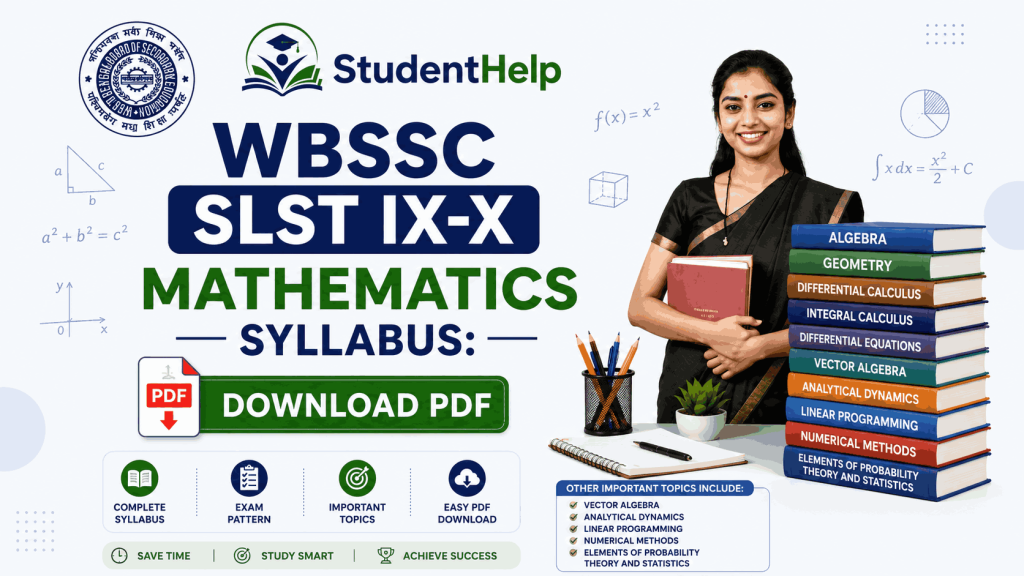
The WBSSC SLST IX-X Mathematics syllabus is primarily based on the West Bengal Board of Secondary Education (WBBSE) curriculum for Classes IX and X, along with fundamental Mathematics concepts expected from a graduate-level candidate aspiring to teach secondary school students. The syllabus typically covers topics such as Algebra, Geometry, DIFFERENTIAL CALCULUS, INTEGRAL CALCULUS, DIFFERENTIAL EQUATIONS, VECTOR ALGEBRA, ANALYTICAL DYNAMICS, LINEAR PROGRAMMING, NUMERICAL METHODS, and ELEMENTS OF PROBABILITY THEORY AND STATISTICS. Candidates should focus on conceptual understanding, problem-solving skills, and teaching aptitude related to Mathematics. Referring to the latest official WBSSC SLST syllabus PDF is recommended to ensure complete and updated preparation.
How many WBSSC Assistant Teacher vacancies are there in 2025?
The WBSSC SLST 2025 Assistant Teacher Recruitment has announced a total of 35,726 vacancies for government-aided and sponsored schools in West Bengal. Out of these:
Classes IX–X (Secondary Level): 23,212 vacancies
Classes XI–XII (Higher Secondary Level): 12,514 vacancies
For Mathematics (Classes IX–X), the exact subject-wise vacancy count is 3500.
What is the WBSSC Assistant Teacher Maths Exam Pattern?
The WBSSC SLST IX–X Mathematics Exam is conducted in an OMR-based (offline) format and consists of Multiple Choice Questions (MCQs). The written examination carries 60 marks with 60 questions, where each question is worth 1 mark. The total exam duration is 90 minutes (1 hour 30 minutes), and there is no negative marking for incorrect answers. The question paper is available in English and Bengali.
Written Examination (OMR) – 60
Educational Qualification – 10
Teaching Experience – 10
Oral Interview – 10
Lecture Demonstration – 10
Has the WBSSC SLST Maths Syllabus been released officially?
Yes. The WBSSC SLST Mathematics Syllabus for Classes IX–X has been officially released by the West Bengal Central School Service Commission (WBSSC) along with the SLST 2025 recruitment notification. The syllabus outlines the important Mathematics topics, exam pattern, and subject areas from which questions will be asked in the written examination. Candidates preparing for the Assistant Teacher (Mathematics) post should follow the official syllabus to ensure focused and effective preparation. It is advisable to download the latest syllabus PDF from the official WBSSC website and prepare according to the prescribed topics and exam pattern.
