Don’t dread those “tell me about a time when…” or “….what are you doing now” interview questions. Have a few solid interactive stories prepared so you’ll always nail your answer.
Whether it’s for a government or private sector job, you must thoroughly understand the type of person they are looking for and what qualities the hiring team is seeking. Then, assess whether you possess those qualities. Prepare for both the exam or interview and the actual job responsibilities. In your free moments, stand in front of a mirror and ask yourself openly: Am I truly fit for this job? What preparation do I need? Ensure you are ready, because many candidates apply for each position. Interviewers are selecting from a large pool and will choose only those candidates who can fulfill the role to their satisfaction.
After long preparation, when the moment of the interview approaches, you try to enter the interview room with a calm, open mind—or you do. Now, when the interviewer asks this dreaded question—”Tell me, what are you doing right now?”—two scenarios may come to mind. The first scenario is that you might think it’s such a simple question, so you say something random that comes to mind. But from that, it won’t be evident that you are a suitable candidate. The interviewer will see no alignment between what you are currently doing and the job you’re applying for, and you won’t seem suitable. The second scenario is that you panic—you get overwhelmed, your mind goes blank, you stumble over your words, and your response comes out awkward and fragmented. In this case, too, it will show that you cannot balance your current activities with the role, and you won’t appear as the right candidate. These two scenarios can occur. That’s why you should follow our preparation guide. You must have a few well-prepared stories ready for your job interview. Presenting these will show that what you’re currently doing and the job you want are aligned. You’ll prove yourself as the responsible, mature candidate they can rely on.
Your best lead is to have a few stories prepared and ready to go for your next job interview. Here are the five big ones you should make sure to have in your arsenal. They’re general enough that they can be used for a variety of questions, but specific enough that the person asking will feel like he or she’s getting a good, solid, detail-filled response. (Make sure you understand the STAR Method and how to use it effectively. When combined with these stories, it can help you deliver structured, impactful answers that demonstrate your skills, experience, and suitability for the role.)
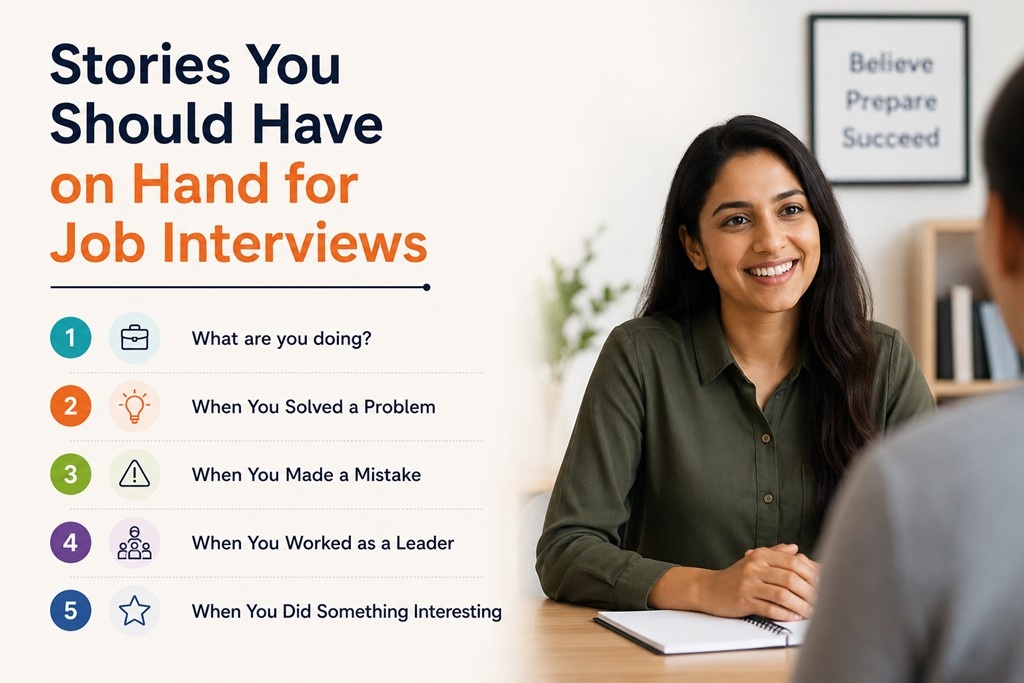
1. What are you doing?
Let me tell you a story—try to grasp the idea. We’ve all heard the story of Cinderella, where a prince is searching for a girl with certain qualities. When he finds those qualities in a village woman, he makes her his queen.
Reality works similarly. If what you are currently doing in life reflects the qualities that the interviewer is looking for, and you can effectively showcase them, you stand out from the crowd of job applicants.
That’s why, if your real-life skills align with the job’s requirements, you’ll be chosen. So, identify the key skills needed for the job you’re interviewing for and craft a story from your own experience that highlights those skills. Present it in a way that shows you’re already living those competencies.
2. When You Solved a Problem
You’ve probably noticed that “problem-solving skills” appear in almost every job description. However, simply listing yourself as a problem solver on your resume isn’t enough—you need to demonstrate it with real examples.
Think about situations where you successfully handled a challenge. Did you help resolve a disagreement between coworkers? Were you able to arrange a replacement speaker for an event when the original presenter canceled at the last minute? Examples like these show your ability to stay calm, think creatively, and take initiative under pressure.
Before your interview, reflect on your past experiences and identify a specific situation where you overcame an obstacle or found an effective solution. Choose an example that highlights your resourcefulness, adaptability, and willingness to step up when needed. Concrete stories that show how you approached a problem and achieved a positive outcome will leave a much stronger impression than simply claiming you have problem-solving skills.
Those tricky behavioral interview questions are enough to immediately make your forehead clammy. But, they’re also a perfect opportunity to demonstrate that you’re a great fit for the job position. Have these five stories at the ready, and you’re sure to ace your next job interview!
Here’s a rewritten version that is suitable for a global audience of job seekers and website visitors:
3. When You Made a Mistake
Everyone makes mistakes—it’s a natural part of learning and professional growth. Employers understand this and don’t expect perfection. What they do want to know is how you respond when things go wrong. Do you take responsibility, or do you try to avoid the issue?
When preparing for an interview, think of a genuine workplace mistake you made. It doesn’t need to be a major failure; in fact, a smaller, manageable mistake is often a better choice. The key is to demonstrate accountability, problem-solving skills, and a willingness to learn.
Start by briefly describing the situation and the mistake you made. Then focus on the actions you took to correct it, minimize its impact, and prevent it from happening again. Finally, explain what you learned from the experience and how it helped you become a more effective professional.
Remember, the purpose of this answer is not to highlight your mistake but to show your integrity, resilience, and commitment to continuous improvement. A thoughtful response can reassure employers that you are capable of learning from challenges and growing stronger because of them.
4. When You Worked as a Leader
You’ve probably heard of the movie “Marriage at 60.” I’m sure you’ve seen it. In that film, there’s a 60-year-old man whose wife had passed away long ago. In her absence, he struggled to manage household tasks—taking care of the home, the garden, and his young child. So, that 60-year-old man married a friend, and together they lived the rest of their lives happily. The woman managed the household smoothly and took great care of the man’s child. Later, when grandchildren came along, she also lovingly cared for them.
In the same way, any organization that hires you wants someone who can step in and keep things running. They seek someone with leadership skills, someone who will take responsibility, and someone who will get the job done. In both government and private companies, there are countless capable individuals with leadership roles—people who can take charge, collaborate, work in teams, influence others positively, and bring a mature approach. Employers want to find people like that.
So, always have a story ready that proves you are a capable candidate—someone who can take responsibility and lead the work effectively.
5. When You Did Something Interesting
Interviewers are interested in more than just your qualifications and work experience. Once they see that you have the skills required for the role, they often want to learn more about you as a person. Your interests, achievements, and experiences outside of work can reveal valuable qualities such as determination, leadership, adaptability, and commitment.
Be prepared to share a meaningful experience that demonstrates your character and work ethic. This could be completing a challenging project, volunteering in your community, participating in sports, learning a new skill, leading a team activity, or overcoming a difficult personal challenge. Experiences that required perseverance, discipline, and problem-solving are particularly valuable because they show your ability to perform under pressure and remain focused on achieving goals.
For candidates seeking government, public sector, or private-sector positions, choose an example that highlights qualities employers value, such as working effectively in difficult conditions, helping others, managing responsibilities, adapting to change, or demonstrating leadership. Explain what you did, the challenges you faced, and the positive impact of your actions.
A well-chosen story can make you more memorable and help employers see that you are not only qualified for the job but also capable of handling challenges, supporting colleagues, and contributing positively to the organization.